Speaker: Yaping Yang
These notes are from a talk given by Yaping Yang at the University of Melbourne during semester 1, 2026. Her talk was an introduction to the (geometric) representation theory of quantum groups, demonstrating results and definitions for quantum-.
Interest in quantum groups in the 1980s came from the discovery of quantum integrable systems such as the Yang-Baxter equations
relating maps of vector spaces . The Yang-Baxter equation can be thought as the algebraic side of the Reidemeister relation
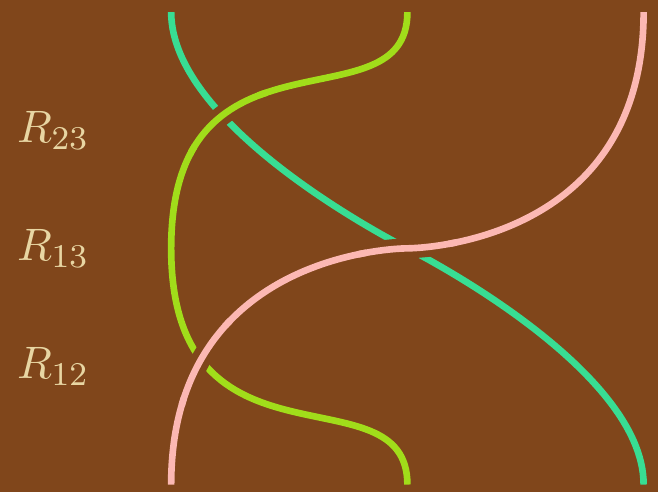
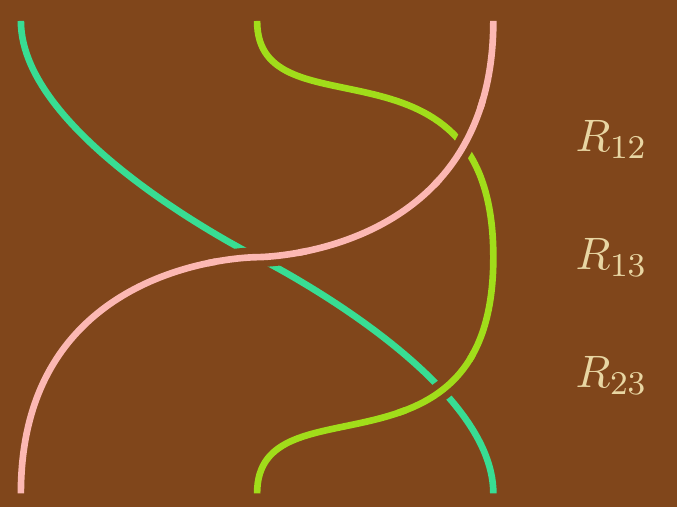
under a topological field theory correspondence. As a result, understanding the algebra of the Yang-Baxter equation translates into topological and geometric data. Drinfeld and Jimbo developed the algebraic formalism unifying these systems by deforming the universal enveloping algebra of a semisimple Lie algebra.
For the Lie algebra and its standard triple of generators
the universal enveloping algebra is
The enveloping algebra is a -algebra, and -deformation creates a related -algebra having four generators and relations
We can specialise parameters to see the relation to : letting , , and the corresponding matrix exponentials, taking the limit recovers .
The quantum deformation can therefore be thought of as a deformation of in one 'direction'. The general definition for a semisimple Lie algebra/Kac-Moody group can be found here.
Hopf algebra structure
The deformed algebra carries a Hopf algebra structure with the comultiplication map
defined by
The Hopf algebras coming from these -deformations have the special property that . Yang-Baxter -matrices1 intertwine the multiplications, .
Representations of
For a generic choice of complex parameter , one has
In these cases, representations of intertwine -actions with multiplication by .
Category
Category is an abelian category containing all finite semisimple modules and all Verma modules. The integral subcategory consists of modules built using the integral weights of the Lie algebra .
Working with for simplicity, for each weight let be the finite-dimensional weight module which is a quotient of the weight- Verma module. This means that is generated by a single highest-weight vector such that
where is the simple dominant coroot of .
The integral subcategory consists of all -modules where
- The action of on is diagonalisable, with eigenspace decomposition
- For all , is finite-dimensional.
Theorem: The simple objects of are the weight modules with regular dominant integral weights,
With this phrasing, the theorem generalises to arbitrary after correctly identifying the weight lattice. Since denotes the dominant integral weights, we also write for the set of regular weights in .
Theorem: For all modules ,
where sends to its character and is the idempotent associated with . The character is determined by a Weyl character formula.
In the case, and , act by raising/lowering:
Of course, .
Integral form
Let , and let
with . This formula is called the -binomial. Its first values are
Using this formula we define the -factorial
The divided power quantum algebra is the -subalgebra of generated by the elements
for . Lusztig's quantum algebra for the th root of unity is defined to be
where the notation means we make into an -module with acting by . This is distinct from the more intuitive de Concini-Kac quantum group .
The parameter reduces the generating set of dividing powers to a finite set . As an example, gives
so that the denominator disappears.
Defining in the same way for as for , the eigenvalues are all given in terms of :
This module is no longer irreducible, but the quotient replaces it.
Lusztig's Theorem KL91: Let . Then the character of is given by the formula
where is the Kazhdan-Lusztig polynomial with parameters and ....
Footnotes
- This is a simplification of the structure: the canonical -matrix for is expressed by an infinite sum, so it can only be written as a finite rank matrix within a representation. In general there are multiple choices of -matrix satisfying the Yang-Baxter equation and intertwining the comultiplications. There are also solutions to the Yang-Baxter equation which cannot come from a universal -matrix ChariPressley95 §4.2 §8.3.
- Some recent papers: Quantum Toroidal Algebras, Quasimaps, Coulomb Branch, Quantum Groups, Shuffle Algebras and Zastava, Category Truncated Yangians.
References
- I recommend EtingofSemenyakin21 for learning modern perspective and practice problems.
- AndersenMazorchuk14 studies category for generic parameters and Lusztig's quantum group, also including projectives and injectives.
- Category has deeper structural properties and relations to geometry than we have covered. A source for this (for representations of ) is the book Representations of Semisimple Lie Algebras in the BGG Category by James Humphreys (archived prepublication copy here).
- Induction functors for quantum algebras are studied in AndersenPoloKexin91. See also the survey Andersen22 for a contemporary survey on connections to cohomology of flag varieties.
- The approach to representations of through quiver varieties is detailed in Lusztig91 and BeilinsonLusztigMacPherson90. See Nakajima01 for the geometric representation theory of affine quantum algebras.
- De Concini and Kac study the 'generic parameter' version of the quantum enveloping algebra when is taken to be a root of unity.